
Looking For Something Florida Keys Related?
Search here for what you want (ads also appear)
Search here for what you want (ads also appear)
Florida Panther National Wildlife
Refuge Is A Safe Haven
The Florida Panther National Wildlife Refuge (FPNWR)is not in the Florida Keys, but a portion of it dips into the northwest section of Everglades National Park.
The Florida Panther sanctuary headquarters are located in Naples at 3860 Tollgate Blvd, Suite 300 in the Comfort Inn, Exit 101 off I-75. The phone number for the headquarters is 239-353-8442.
This Refuge provides a safe habitat for the endangered Florida panther which has begun to make a comeback after the introduction of several Texas panthers into the region.
This hardier stock helped to replenish a weak gene pool, and has resulted in the State animal beginning to have a favorable rebound.
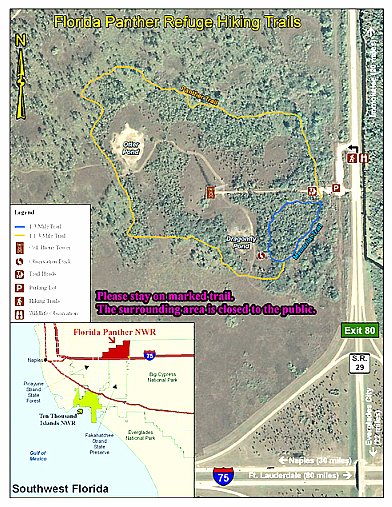
Florida Panther National Wildlife Refuge Map and Hiking Trails
Courtesy of www.fws.gov
Courtesy of www.fws.gov
Flora And Fauna Found
In The Florida Panther Habitat
The 26,400 acres of the Florida Panther National Wildlife Refuge provides the perfect living and hunting grounds for the area's only big cat, as well as for black bear.
In The Florida Panther Habitat
The area is a mix of dense underbrush and hardwood hammocks comprised of cabbage palms, palmettos, cypress, gumbo limbo, and pine which blend into the wet prairie of the Everglades National Park.
The Fakahatchee Strand, which is the largest cypress stand in the Big Cypress Swamp is included in this protected region.
The area had been home to massive cypress trees, but was heavily logged in the mid-1900's severely depleting the cypress supply. Fortunately cypress has begun to regrow in the area. With it's regrowth, some of the areas native orchids, bromeliads and other vegetation has returned as well.
Since the area is home to a number of rare and unique native orchids and bromeliads, an orchid lab is on the premises. This lab is involved in the collection and propagation of these native species and it also serves as the main center for reintroducing these orchids throughout southern Florida.
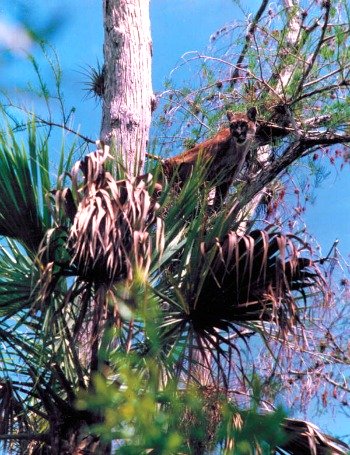

Female Florida Panther In A Tree
State Archives of Florida, Florida Memory, Photo Credit Peter B. Gallagher
State Archives of Florida, Florida Memory, Photo Credit Peter B. Gallagher
With the near perfect Florida climate also comes invasive plants and animals. To help control invasive plant species, controlled burns are performed every year, and they rotate the locations on a 3 - 4 year cycle.
Burns are effective in reducing the competition with native plants, plus they help to prevent uncontrolled burns which are caused by the numerous lightning strikes that occur during the rainy season.
They also help to create more space for animals such as the white tailed deer which is the primary food source of the panther.
With lush vegetation, an abundance of water, the warm Florida weather, and a plentiful supply of deer, rabbit, racoon, fox, wood stork, and other species, this Wildlife Refuge has helped the panther slowly regrow in number.
The Florida Panther National Wildlife Refuge is responsible for promoting better understanding and cooperation between the residents surrounding the area and the agency so the goal of protecting this big cat will succeed.
Looking For Something Florida Keys Related?
Search here for what you want (ads also appear)
Search here for what you want (ads also appear)
Recent Articles


-
Christ of the Abyss, Top Key Largo Diving & Photo Site
 Christ of the Abyss at Key Largo Dry Rocks, best diving, snorkeling and photography site also popular for underwater weddings and funerals.
 -
Flaglers Barge, Top Florida Keys Scuba Snorkeling Site
 Flaglers Barge, close to spectacular Sombrero Reef is a magnificent wreck diving spot that's also perfect for Florida Keys snorkeling.
 -
Cayman Salvage Master, Unusual Advanced Key West Dive Site
Cayman Salvage Master is an intact, top scuba diving Key West site to explore when wreck diving, due to unusual features left on board by passengers.
You May See Ads Here
You May See Ads Here


SAVE BIG WITH THESE
KEY WEST DISCOUNTS
KEY WEST DISCOUNTS

Local Weather Zip Codes
Key Largo - 33037
Marathon - 33050
Key West - 33040
Key Largo - 33037
Marathon - 33050
Key West - 33040
|





FTC Compliance Disclaimer and Affiliate Program Sponsor Disclosure
As an Amazon Associate I earn from qualifying purchases such as the various
items displayed on my website available through Amazon. We also earn
advertising fees by advertising and linking to other affiliate sites
florida-keys-vacation.com is associated with including but not necessarily
limited to Amazon, Conversant/Commission Junction, Fishingbooker.com,
Google Adsense, and Sitesell.
Florida-Keys-Vacation.com, does not sell any personal information and you
can read about this and the California Consumer Protection Act
on our Privacy Policy page.
We are currently testing various affiliate monetization options, including
Conversant/Commission Junction, Adsense, Sitesell, Fishingbooker
and Amazon Associates Affiliate Program. Expect to see a variety
of banner, image, and text link ads throughout this site, in various places,
as we try out different sizes, styles, formats, companies and programs, to
determine which ones are a best fit for this site. You can expect to see
ads moved and changed until we find the ones we feel best fits our goals.
We've been approved by Google to participate in one of their Google ad
programs, that displays "intelligent" and "responsive" ads based off of YOUR
internet browsing search history, showing you ads based of YOUR interests.
These new AI ads are part of Google's artificial intelligence program, known
as RankBrain, and are displayed based on which web site you've visited in
the last 28 days, as well as items you've bought off online stores, and any
search terms you've typed into your browser. We may occasionally opt into
this ad program but we have no control over what ads this AI ad program
displays, as the ads are based off your browser history and not our
web site topics.
To learn more about the FTC laws you can visit the FTC and also go to
their rules and guides page.
Promotions, discounts and offers identified throughout this website are made
available through a variety of sources including the above listed affiliates of
florida-keys-vacation.com. As such, this website may receive compensation
for products and services that are subsequently purchased through the
referred affiliate. These monies help fund, operate and maintain this website.
In operating this website we are associated with a variety of other companies.
They may be social media websites, or affiliate organizations that sell a variety
of products through merchants such as Conversant/Commission Junction or
Amazon, Google and their different product lines, as well as Fishingbooker.com
and Sitesell.
The following list of companies and social media groups we're associated with
provides links to their different pages, which include Privacy Policy, Cookie
Policy and other important disclaimers.
Adsense EU User Consent Policy
Adsense Privacy Policy
Amazon Privacy And Cookie Policies
Conversant/Commission Junction Privacy Policy
Facebook Cookies & Other Storage Technologies Policies
Facebooks Data Policy
Facebooks Terms And Policies
Fishing Booker Privacy Policy
Google Ad And Network Policy
Google Analytics Opt Out Tool
Google Cookies
Google EU User Consent Policy
Google Policy On Personalized Ads
Google Privacy Policies For All Google Services
Pinterest Cookies Policy
Pinterest Privacy Policies
Sitesell Privacy Policy
Reddit Privacy Policies
Tumblr Privacy Policies
Twitter Privacy Policies
YouTube Privacy Policy
items displayed on my website available through Amazon. We also earn
advertising fees by advertising and linking to other affiliate sites
florida-keys-vacation.com is associated with including but not necessarily
limited to Amazon, Conversant/Commission Junction, Fishingbooker.com,
Google Adsense, and Sitesell.
Florida-Keys-Vacation.com, does not sell any personal information and you
can read about this and the California Consumer Protection Act
on our Privacy Policy page.
We are currently testing various affiliate monetization options, including
Conversant/Commission Junction, Adsense, Sitesell, Fishingbooker
and Amazon Associates Affiliate Program. Expect to see a variety
of banner, image, and text link ads throughout this site, in various places,
as we try out different sizes, styles, formats, companies and programs, to
determine which ones are a best fit for this site. You can expect to see
ads moved and changed until we find the ones we feel best fits our goals.
We've been approved by Google to participate in one of their Google ad
programs, that displays "intelligent" and "responsive" ads based off of YOUR
internet browsing search history, showing you ads based of YOUR interests.
These new AI ads are part of Google's artificial intelligence program, known
as RankBrain, and are displayed based on which web site you've visited in
the last 28 days, as well as items you've bought off online stores, and any
search terms you've typed into your browser. We may occasionally opt into
this ad program but we have no control over what ads this AI ad program
displays, as the ads are based off your browser history and not our
web site topics.
To learn more about the FTC laws you can visit the FTC and also go to
their rules and guides page.
Promotions, discounts and offers identified throughout this website are made
available through a variety of sources including the above listed affiliates of
florida-keys-vacation.com. As such, this website may receive compensation
for products and services that are subsequently purchased through the
referred affiliate. These monies help fund, operate and maintain this website.
In operating this website we are associated with a variety of other companies.
They may be social media websites, or affiliate organizations that sell a variety
of products through merchants such as Conversant/Commission Junction or
Amazon, Google and their different product lines, as well as Fishingbooker.com
and Sitesell.
The following list of companies and social media groups we're associated with
provides links to their different pages, which include Privacy Policy, Cookie
Policy and other important disclaimers.
Adsense EU User Consent Policy
Adsense Privacy Policy
Amazon Privacy And Cookie Policies
Conversant/Commission Junction Privacy Policy
Facebook Cookies & Other Storage Technologies Policies
Facebooks Data Policy
Facebooks Terms And Policies
Fishing Booker Privacy Policy
Google Ad And Network Policy
Google Analytics Opt Out Tool
Google Cookies
Google EU User Consent Policy
Google Policy On Personalized Ads
Google Privacy Policies For All Google Services
Pinterest Cookies Policy
Pinterest Privacy Policies
Sitesell Privacy Policy
Reddit Privacy Policies
Tumblr Privacy Policies
Twitter Privacy Policies
YouTube Privacy Policy
You can read more about our Sponsor Disclosure and Privacy Policy here.
© Copyright 2011 - 2024 Florida-Keys-Vacation.com - All rights reserved
This DMCA site is protected under U.S. and International copyright laws.
Do Not Copy. No use is allowed without written permission.
This DMCA site is protected under U.S. and International copyright laws.
Do Not Copy. No use is allowed without written permission.
Florida-Keys-Vacation.com content written by Cathy Sheehan
Comments!
Do you have anything to add? We look forward to feedback on what you've just read so leave me a comment in the box below.